
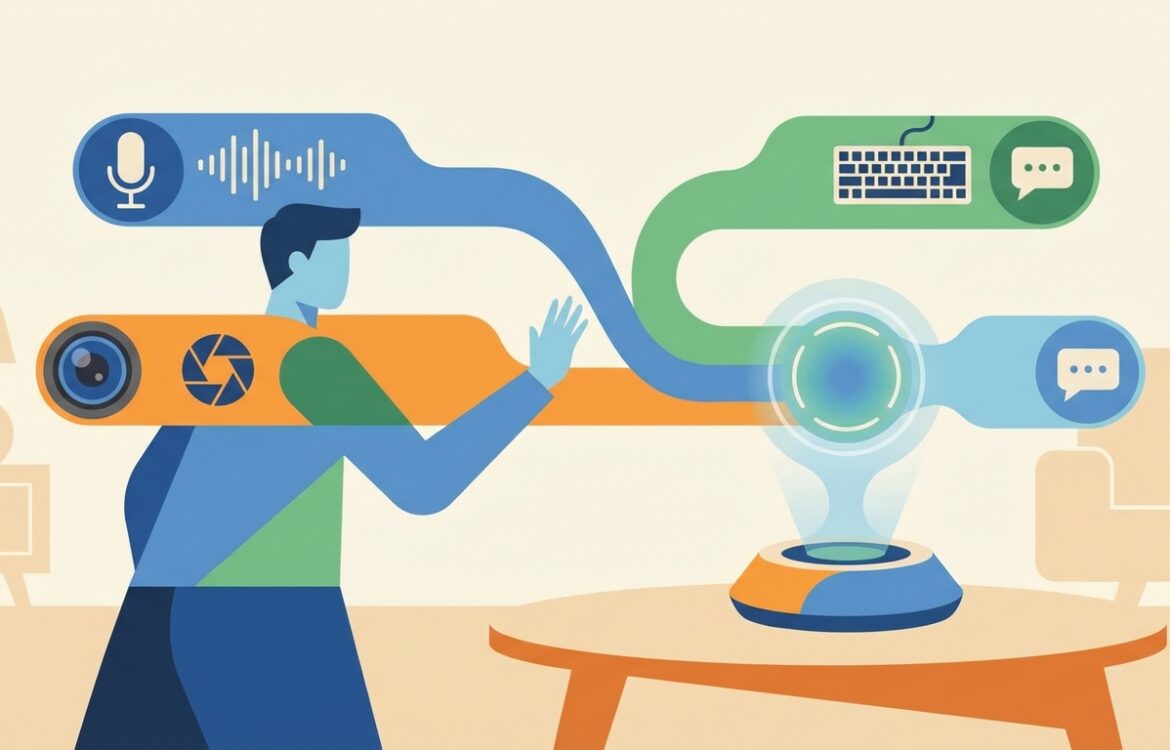
Multimodal AI: The New Default Interface — Evidence, Drivers, and Practical Implications
This article examines whether and how Multimodal AI is becoming the new default interface for people and organizations. I review documented signals from major platform vendors, benchmarks and academic surveys, industry analyses, and emerging standards; separate what is verified from what remains uncertain; and outline practical implications and metrics teams can watch. Key claims are supported by primary sources where available.
What is happening now (verified signals) — Multimodal AI
Large technology vendors and research groups have released multiple, natively multimodal models and product features in the last two years: Google’s Gemini series (including 1.5 and product integrations like AI Mode), OpenAI’s GPT‑4o updates and image generation features, and several open-source multimodal releases from research labs. These products explicitly accept or generate multiple media types (text, images, audio or video) rather than treating multimodality as a bolt‑on capability. (blog.google)
Vendors are pushing multimodal capabilities into mainstream applications: image understanding and long-context analysis in Google’s Gemini and Search AI Mode, image and vision fine‑tuning in OpenAI’s GPT‑4o, and multimodal moderation and safety tools. These announcements are product‑level signals that multimodal inputs/outputs are being operationalized, not just prototyped. (blog.google)
Academic and community benchmarking work is maturing: several benchmark suites and evaluation frameworks (MMBench, MME, HEMM and more recent MPBench/MPBench derivatives) are being published to measure perception, alignment, and cross‑modal reasoning. The research literature shows that models have improved in many perceptual tasks but still struggle with compositional reasoning, attribution, and cross‑modal hallucinations. (arxiv.gg)
Standards and governance bodies are responding. The IEEE has adopted and advanced standards addressing multimodal conversation and related interfaces, and W3C work from a previous Multimodal Interaction activity provides a foundation for accessible multimodal web interfaces. Those activities indicate institutional attention to interoperability and accessibility for multimodal interactions. (standards.ieee.org)
What’s driving the change
Several technical and non‑technical forces are converging to make multimodal interfaces practical:
-
Model capability and architecture advances: architectures that fuse modalities and larger pretraining corpora have improved raw capability, and innovations such as mixture‑of‑experts and longer context windows enable richer cross‑modal context handling. These advances are reflected in vendor model releases and platform notes. (blog.google)
-
Product integration incentives: embedding multimodal models into search, assistants, and productivity tools increases user leverage—users can ask questions about images, upload files for long‑context analysis, and get richer outputs without switching apps. Google and OpenAI product notes document these integration priorities. (blog.google)
-
Lowered compute and tooling costs: research into resource‑efficient multimodal training and smaller, specialized models (including open‑source releases) reduces the barrier to entry for startups and internal teams to experiment with multimodal features. Surveys of resource‑efficient models summarize this direction. (arxiv.org)
-
Enterprise demand for richer inputs: businesses see immediate use cases in document + image processing, customer support (voice + visual context), and fraud detection where cross‑checking multiple signals increases value. Industry analyses and consultancy offerings highlight enterprise pilots and packaged multimodal products. (mckinsey.com)
What experts and credible sources disagree about
There is substantive, documented disagreement across three broad questions: whether multimodality materially reduces hallucinations, how quickly multimodal agents will become pervasive, and whether the locus of capability will be cloud or device.
-
On hallucinations: some industry commentary and vendor summaries frame multimodal context as a way to reduce hallucinations by grounding outputs in perceptual inputs. However, benchmark‑level evaluations (HEMM, MME and related work) show multimodal models still produce modality‑coupled errors and can compound mistakes across modalities—so the evidence is mixed: more context helps in some tasks but introduces new failure modes in others. Reported improvements in specific vendor demos are not yet equivalent to systematic, cross‑task reductions in hallucination. (mckinsey.com)
-
On adoption speed and ubiquity: consultancies and vendors forecast broad incorporation of multimodal features into mainstream apps, and many pilots exist; yet independent benchmarking and the need for tailored fine‑tuning, safety guardrails, and latency/cost management imply a stepwise, uneven rollout across sectors. McKinsey and Deloitte frame multimodal as an accelerating enterprise trend but stop short of fixed timelines, reflecting uncertainty in operationalization across industries. (mckinsey.com)
-
On cloud vs device: some research (and open models) make the case for on‑device multimodal capabilities, improving privacy and latency; at the same time, flagship multimodal services are largely cloud‑hosted because models with the broadest capability still require substantial compute. The rise of smaller, efficient models and vendor micro‑models suggests both paths will coexist, but there is disagreement about which will dominate for mainstream users. Open‑source releases and vendor notes illustrate both directions. (wired.com)
Where sources disagree, I avoid hard predictions: the literature supports the directional claim (multimodality is growing and being productized) but not precise timelines or singular endpoints. When vendors advertise capabilities, independent benchmarks and peer‑reviewed evaluations should be consulted before treating product demos as general proof of robust behavior in all contexts. (blog.google)
Practical implications (for teams, creators, or users)
For product teams
-
Prioritize use cases where multimodal inputs materially change outcomes (e.g., visual evidence in claims processing, combining notes and scans in healthcare workflows). Proofs of value are strongest when the multimodal fusion reduces human verification work or improves a measurable downstream metric. (mckinsey.com)
-
Plan for hybrid architectures: expect to combine cloud and edge components to balance latency, cost, and privacy. Small‑model inference on device for simple perceptual tasks with cloud fallback for heavy reasoning can be a pragmatic pattern. Vendor offerings and research into efficient models support this hybrid approach. (openai.com)
-
Design for ambiguity and verification: multimodal inputs bring more varied noise sources (blurry images, poor audio). UX patterns that communicate uncertainty, request clarifying inputs, or keep humans in the loop will be essential—research on GUI agents and reflection suggests explicit pause/choice points and error‑recovery flows. (arxiv.org)
For creators and designers
-
Rework interaction models: multimodal interfaces are less about replacing existing controls and more about augmenting them—designers should prototype mixed‑initiative flows where users can combine voice, gesture, and images with typed prompts. W3C multimodal architecture work offers principles for composing modes and managing confidence annotations. (w3.org)
-
Accessibility opportunities and risks: multimodality can broaden access (voice and vision for different abilities) but also raises new barriers if outputs are not described or verified across modalities—standards work and careful UX testing are necessary. (w3.org)
For security, compliance, and legal teams
-
Reassess data governance: multimodal systems combine sensitive data types (images, audio, text) and may cross legal boundaries (biometric data, health images). Privacy assessments and differential storage/retention policies are more complex. Industry guidance recommends human oversight and provenance tracking. (mckinsey.com)
-
Adopt standards and testing: participation in standards tracking (IEEE, W3C) and using established benchmarks can reduce compliance risk and make third‑party claims easier to evaluate. (standards.ieee.org)
What to watch next (signals and metrics)
Operational teams and strategists should track a mix of product, technical, and market signals to assess whether multimodal AI is becoming a default interface in their domain:
-
Platform integrations: monitor releases from major providers (OpenAI, Google, Anthropic, major cloud vendors) for first‑class multimodal APIs and embedded features. Productization at scale is a strong signal. (openai.com)
-
Benchmark convergence: watch whether community benchmarks move from isolated task improvements to consistent gains across a broad set of cross‑modal reasoning and safety tests (e.g., HEMM, MME and successors). Consistent benchmark gains increase confidence in generality. (arxiv.org)
-
Standards and regulatory activity: IEEE, W3C, and regional regulators issuing norms or requirements for multimodal conversational interfaces, privacy, and explainability will shape safer, interoperable deployments. (standards.ieee.org)
-
Open‑source ecosystem: look for capable open models and toolchains (like recent lab releases) that make multimodal stacks feasible without vendor lock‑in; the appearance of production‑grade open libraries is a signal for broader experimentation. (wired.com)
-
Cost and latency trends: track the relative inference cost and on‑device feasibility; falling costs and practical device runtimes indicate a shift toward everyday multimodal UX. Research on resource‑efficient models is relevant here. (arxiv.org)
Example operational metrics teams can monitor:
-
Task success rates for multimodal end‑to‑end flows (vs. unimodal baselines).
-
Frequency of user clarification prompts (an indicator of ambiguity in multimodal understanding).
-
Latency and cost per multimodal session (for cloud vs. on‑device configurations).
-
Safety interventions and false positive/negative rates in multimodal moderation pipelines.
FAQ
What is multimodal AI and why is it becoming the default interface?
Multimodal AI refers to models that accept and/or generate multiple data types (text, images, audio, video, sensor data) in a unified way. It is increasingly used as an interface because major vendors are embedding multimodal capabilities into search and assistant products, benchmarks show expanding capabilities, and enterprises see practical cross‑modal use cases (e.g., document + image processing). However, being “the default” will depend on domain‑specific cost, latency, privacy, and safety tradeoffs. (blog.google)
Do multimodal models reduce hallucinations?
Evidence is mixed: additional context (images, documents) can ground outputs and help in some tasks, but multimodal models can still hallucinate and may compound errors across modalities. Published benchmarks and evaluation frameworks find improvements on certain perceptual tasks but identify persistent reasoning and attribution failure modes. Independent evaluation is essential before assuming a multimodal model is less prone to error. (arxiv.org)
Can multimodal AI run on phones or must it be cloud‑hosted?
Both. There are smaller, efficient multimodal models and optimizations suited for devices, and there are larger models that currently require cloud infrastructure. Many practical deployments will mix on‑device perceptual processing with cloud reasoning. The balance depends on privacy needs, latency, and model size. Recent open‑source releases and vendor notes describe both paths. (wired.com)
How should organizations evaluate multimodal vendors and models?
Use a combination of independent benchmarks (perceptual and reasoning tests), domain‑specific pilots, security and privacy assessments for each modality, and close scrutiny of vendor claims with reproducible tests. Standards bodies and community benchmarks are useful reference points. (arxiv.gg)
This article is for informational purposes and does not constitute investment or business advice.
Summary: the weight of evidence shows multimodal AI moving from exploratory research into productized interfaces—major vendors have shipped multimodal features, community benchmarks are maturing, and standards activity is increasing. Still, important uncertainties remain about generalization, safety, cost, and the balance between cloud and device deployments. Teams should treat multimodal capabilities as a strategic opportunity that requires disciplined evaluation, careful UX design, and governance rather than a drop‑in replacement for existing interfaces. (openai.com)

I explore how AI is reshaping work, creativity, education, and decision-making, grounding every topic in evidence rather than hype. I write about real trade-offs—open vs closed models, compute costs, information quality, and organizational impact—so readers can understand what actually matters and what to watch next.