
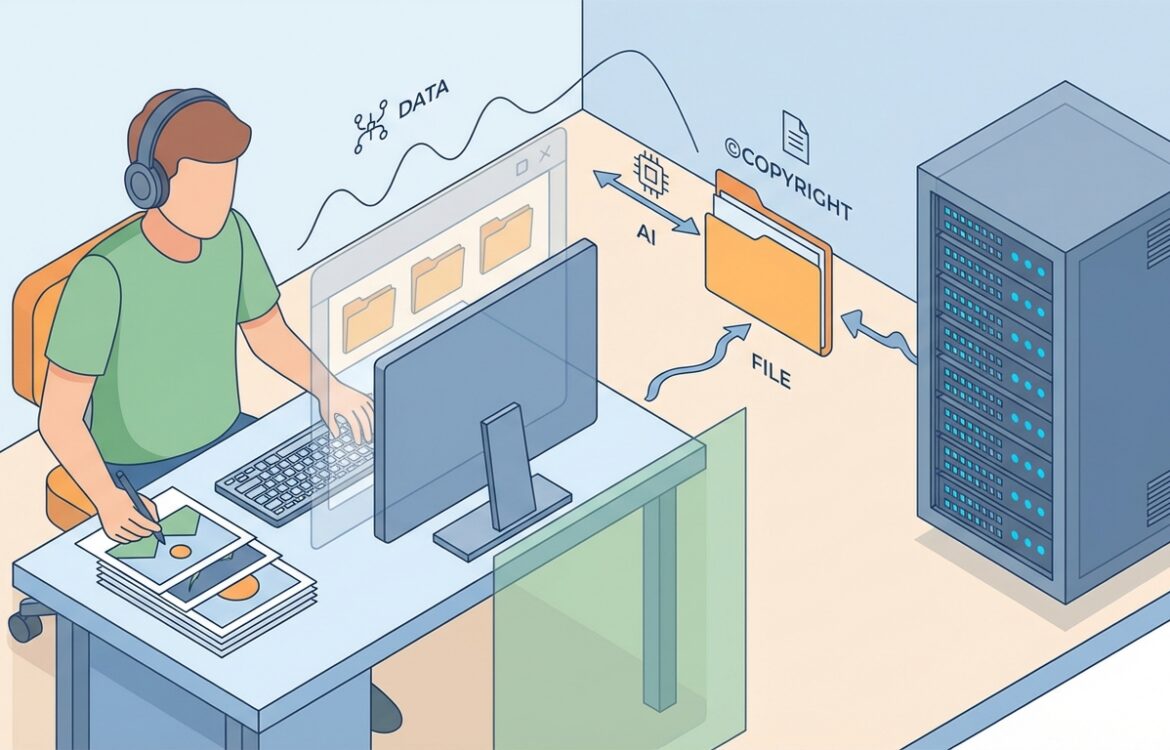
Copyright and AI: What Creators Should Know — A Practical Guide for Creators
This article, “Copyright and AI: What Creators Should Know,” explains how copyright law, regulator guidance, and recent court cases intersect with the use of copyrighted works in training and operating generative AI. It summarizes the current legal landscape across major jurisdictions, highlights practical compliance steps creators and content owners can take now, and points to uncertain areas where policy, litigation, or standards may change outcomes. The goal is informational clarity — not legal advice — to help creators make evidence‑based decisions about control, licensing, and oversight. (copyright.gov)
What the issue is (definitions and boundaries)
At a basic level, the copyright questions around AI divide into two linked issues: (1) whether copying and using existing copyrighted works to assemble or train AI datasets and models requires permission or may qualify as an exception such as fair use (U.S.) or text‑and‑data‑mining (TDM) exceptions (EU/UK); and (2) whether outputs produced with the assistance of AI should themselves receive copyright protection and, if so, who (if anyone) is the author or rights holder. These issues are conceptually distinct but interact in practice when model outputs resemble or substitute for protected works. (intellectual-property-helpdesk.ec.europa.eu)
Practically speaking, “training” an AI model usually involves automated copying, transformation, and storage of large numbers of files or records (text, images, audio, code) to create model parameters. Those steps can implicate the reproduction, distribution, and adaptation rights that copyright owners hold. Whether those acts are lawful depends on statutory exceptions, contract terms, or a court’s application of doctrines like fair use in the United States. Several high‑profile lawsuits and regulatory inquiries are testing those boundaries. (arxiv.org)
What the law/regulators/standards say (by jurisdiction if needed)
United States — process and legal tests: U.S. courts evaluate unauthorized uses of copyrighted works for fair use using four statutory factors; courts and agencies are actively considering how those factors apply to large‑scale model training and to the extent outputs substitute for original works. The U.S. Copyright Office has run a multipart initiative and published reports addressing topics such as digital replicas and the broader AI/copyright interaction; those reports and ongoing agency work are intended to inform courts and policymakers. In parallel, multiple private lawsuits alleging unlawful scraping and use of publishers’ and authors’ works are pending or have advanced in U.S. courts, including consolidated author and publisher actions against major model developers. (copyright.gov)
European Union — TDM exceptions and the AI Act: EU copyright law includes targeted text‑and‑data‑mining exceptions that permit certain automated analysis when conditions (such as lawful access) are met, and the EU’s AI Act (and associated templates and codes of practice) adds transparency obligations for providers of general‑purpose AI (GPAI), including requirements to publish summaries describing training data and compliance measures. EU law therefore focuses on both exceptions for research‑style TDM and affirmative transparency and compliance obligations for GPAI providers. (epthinktank.eu)
United Kingdom — consultation and voluntary code: The UK government and the Intellectual Property Office have run consultations and are developing a code of practice on copyright and AI; options under discussion include clarifying whether computer‑generated works should receive protection, whether TDM exceptions should be widened or licensed, and whether voluntary or statutory regimes for licensing will be appropriate. The UK approach has emphasized an attempt to balance support for creative industries and AI innovation while exploring voluntary codes that could, if unsuccessful, lead to legislation. (gov.uk)
Recent case law and enforcement trends: Courts have given important signals that affect fair use analysis (for example, the U.S. Supreme Court’s 2023 decision in Andy Warhol Foundation v. Goldsmith, which clarified aspects of the “purpose and character” fair‑use factor) and judges are explicitly wrestling with whether model training and deployment may cause market harm for creators. Many of the most consequential questions remain unresolved and are currently litigated or subject to agency study. (supreme.justia.com)
Practical compliance steps (documentation, controls, oversight)
For creators and small organizations, practical steps can reduce legal and commercial risk even while doctrinal and regulatory outcomes continue to evolve. The following measures reflect best practices seen in regulator guidance, court filings, and industry white papers.
- Inventory and register valuable works. Maintain clear records of what you own or control, dates of creation and publication, and any registrations. This helps demonstrate ownership and quantify potential claims. (arxiv.org)
- Monitor usage and outputs. Periodically check whether AI outputs on public platforms reproduce or closely resemble your works; document examples with screenshots, timestamps, and metadata. This evidence is generally relevant to any enforcement or negotiation. (caselaw.findlaw.com)
- Use licensing and clear terms. Where possible, require explicit licences for dataset use, or negotiate terms for AI training and derivative rights. Market practice increasingly shows major publishers negotiating commercial licenses with AI providers; licensing can convert uncertainty into revenue and control. (emetresearch.framer.ai)
- Publish machine‑readable opt‑out signals. Consider using robots.txt, metadata, or dataset registries to state access and reuse preferences; while not a legal silver bullet, standardized opt‑out signals help the content‑management and crawler ecosystem and can support arguments about good‑faith reliance or intent. (arxiv.org)
- Contractual safeguards with vendors and collaborators. If you license your content to platforms or AI vendors, include clauses about permitted training use, attribution, revenue share, and auditing rights. Contracts are often the most immediate and enforceable mechanism to set rights. (emetresearch.framer.ai)
- Document provenance and chain of custody. Ask partners and vendors for dataset provenance, license terms, and deletion/segregation processes; the EU GPAI template and other emerging codes encourage public information about training data sources and compliance steps. Keeping provenance records reduces uncertainty and supports negotiations or enforcement. (skadden.com)
- Technical mitigations. Where applicable, ask for or require guardrails such as output filtering, watermark removal protections, and controls that reduce verbatim regurgitation of training material; this can limit market substitution risk and downstream harm. (arxiv.org)
- Policy and business planning. Assess whether licensing, strategic partnerships, or selective enforcement best support your business model; different rights‑holders (news orgs, photographers, authors, musicians) are taking divergent approaches, including commercial deals, litigation, and collective bargaining. (emetresearch.framer.ai)
Common misconceptions and risky shortcuts
Several misconceptions are common and can lead creators to take risky shortcuts.
- “If it’s on the open web, anyone can use it for training.” Not necessarily. The legality of scraping publicly accessible content depends on jurisdiction, contract terms and the intended use; in the EU and UK, lawful access and TDM exceptions have specific limits, and in the U.S. courts will apply fair use analysis. Treat public availability as one factor, not an automatic legal clearance. (intellectual-property-helpdesk.ec.europa.eu)
- “Model weights never contain copies, so there’s no copyright issue.” Some courts and commentators have held that model parameters are not literal reproductions; others emphasize that the dataset creation steps and observable outputs may still give rise to reproduction or market‑harm claims. This technical point does not eliminate legal exposure. (paulweiss.com)
- “A single lawsuit will settle the law.” Litigation is likely to produce region‑specific precedent that clarifies parts of the problem, but multiple suits (different facts, different media—text, images, music) and regulatory rules will shape a patchwork of outcomes for some time. Relying on a single published decision as the final answer is premature. (caselaw.findlaw.com)
- Ignoring contracts and metadata is harmless. Contracts, dataset licenses, and machine‑readable metadata are often decisive in commercial and litigation contexts; failing to use them misses practical protections. (arxiv.org)
Open questions and what could change
Several open questions could materially change how creators approach AI over the next few years:
- How courts will apply fair use or equivalents to large‑scale training. A definitive appellate or Supreme Court ruling in a major training case could reframe the playing field in the U.S.; meanwhile, U.S. agency reports and DOJ/Executive guidance could influence administrative outcomes. (uspto.gov)
- How EU GPAI transparency rules and templates are implemented. The EU’s GPAI templates and Code of Practice are intended to increase dataset transparency and could require public summaries that allow rights holders to assess and enforce their rights. How granular that public reporting must be will matter. (skadden.com)
- Whether licensing markets consolidate or fragment. Some large publishers have negotiated multi‑million dollar deals with AI firms; whether that model becomes widespread or whether opt‑outs, regional bans, or compulsory licensing regimes emerge is uncertain. Market incentives and litigation outcomes will shape this. (emetresearch.framer.ai)
- Technical standards for provenance and auditing. Auditable dataset provenance, standardized metadata, and third‑party audits may become accepted compliance tools. Academic audits and data‑provenance projects already show widespread inconsistency in dataset licensing and attribution; standardization would reduce friction. (arxiv.org)
This article is for informational purposes and does not constitute legal advice.
FAQ
Q: Does training an AI model on my published works always require permission?
A: Not always — the answer depends on jurisdiction, how the works are accessed and copied, the purpose of the training, and whether an exception (for example, U.S. fair use or EU/UK TDM exceptions) applies. Courts and agencies have not resolved every context, and pending litigation and regulator guidance are actively clarifying the boundaries. Creators should document and, where appropriate, assert their licensing preferences and pursue contractual protections. (copyright.gov)
Q: If an AI output looks like my work, what should I do first?
A: Preserve evidence (timestamped copies, URLs, prompts if available), review the platform’s terms and takedown procedures, and consider seeking professional legal advice about next steps. Many creators begin by asking the platform or provider for provenance details or a takedown; documenting communications is important for any subsequent negotiation or enforcement. (arxiv.org)
Q: Will new laws require AI companies to disclose training data?
A: Several regulatory initiatives aim to increase transparency: the EU’s GPAI requirements and templates include public disclosure duties for general‑purpose AI providers, and other jurisdictions are considering reporting or code‑of‑practice approaches. These obligations are evolving and differ by region. (skadden.com)
Q: Are licensing deals a realistic route for individual creators?
A: Large publishers and platforms have reached bilateral licences with AI firms; for many individual creators the scale and bargaining power differ. Collectives, unions, or licensing marketplaces may improve access to licensing markets for individuals. In parallel, creators can use contracts, metadata, and technical measures to assert rights and negotiate terms. (emetresearch.framer.ai)
Q: How should creators prepare now, while the law is still unsettled?
A: Prioritize documentation of ownership and provenance, consider machine‑readable opt‑outs and clear licensing terms, monitor model outputs for harms, and engage (individually or via collectives) in licensing or policy conversations. Treat litigation and regulation as possible futures and build flexible commercial strategies that include both defensive documentation and proactive partnerships. (arxiv.org)

I write about how AI actually gets built, governed, and used in the real world. My focus is on practical, evidence-based guidance around AI safety, regulation, privacy, and responsible deployment—especially where policy meets day-to-day engineering and operations.