
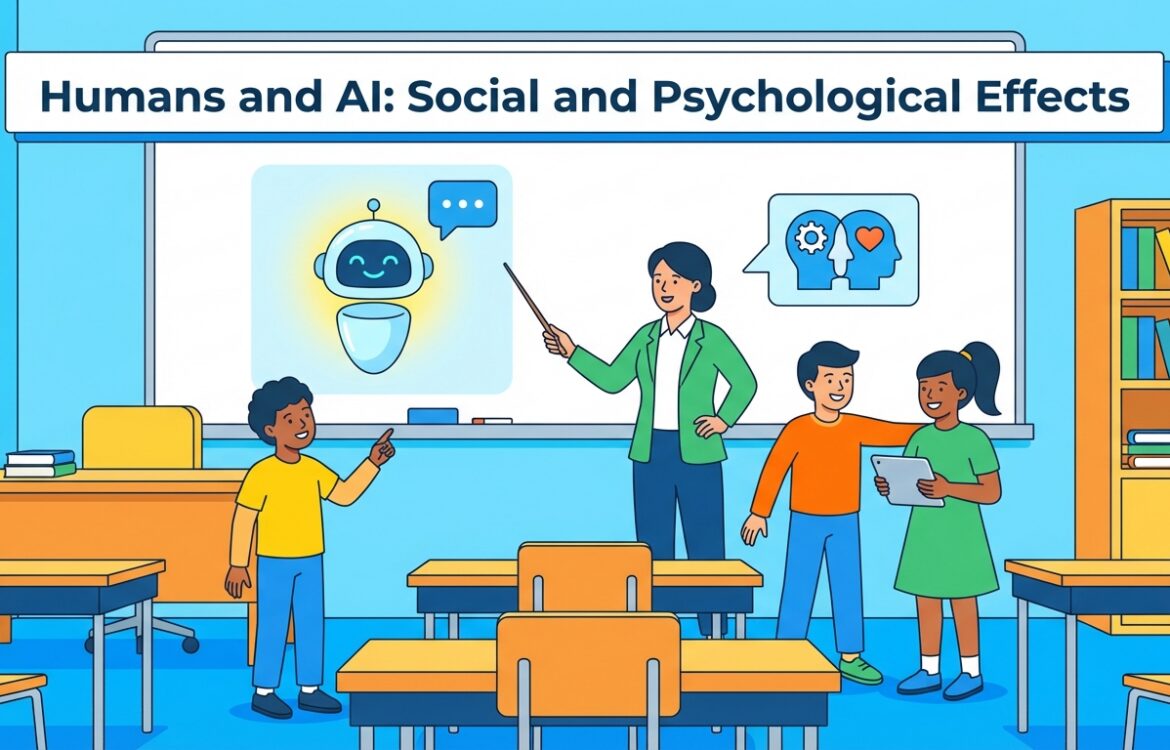
Humans and AI: Social and Psychological Effects — What the Evidence Says About Work, Learning, Creativity and Relationships
As AI systems become part of everyday life, questions about Humans and AI: Social and Psychological Effects move from abstract debate to concrete experiences. This article summarizes current, research-based signals about how AI is changing work, learning, media and relationships; lists benefits people report (and their limits); sets out concerns with the evidence level for each; explains how different groups are affected; and offers practical guidance for individuals, educators, employers and policymakers. It draws on major surveys, peer-reviewed trials and policy guidance so readers can separate documented effects from speculation. (pewresearch.org)
What is changing (observable signals) — Humans and AI: Social and Psychological Effects
Several measurable signals point to rapid social and psychological change where AI tools are in everyday use. First, public and worker perceptions are shifting: multiple nationally representative surveys show many people expect AI to affect jobs and hiring practices, and substantial shares of workers report either some current use of AI at work or the potential for AI to do parts of their jobs. (pewresearch.org)
Second, large economic analyses and industry reports estimate substantial productivity gains if generative AI is widely adopted, concentrated in customer operations, marketing, software engineering and R&D—signaling changing job tasks and organizational design rather than uniform mass layoffs in the short term. (mckinsey.com)
Third, education systems and assessment practices are being tested: researchers have demonstrated that AI-generated answers can pass—or even outperform—students on some take-home and online assessments, prompting policy shifts and institution-level guidance on assessment design and AI literacy. (theguardian.com)
Fourth, content ecosystems show mounting evidence that synthetic media (“deepfakes”) and AI-amplified misinformation complicate trust in news and social media; detection tools are imperfect and users often misjudge whether material is AI-generated. (washingtonpost.com)
Fifth, people are forming novel social relationships with conversational agents and companion apps; early peer-reviewed studies and field surveys describe both therapeutic-style benefits for some users and risks of dependency or boundary problems for others. (mental.jmir.org)
Benefits people report (with limits)
When researchers and surveys ask users what they gain from AI tools, several recurring benefits appear—though the evidence often includes important caveats.
-
Time savings and productivity support: organizations and many workers report that AI can automate routine parts of knowledge work—drafting emails, summarizing documents, producing first drafts of marketing copy or code suggestions—freeing time for higher-order tasks. Economic analyses estimate large potential value if adoption is paired with organizational change. However, these gains depend on high-quality integration, worker retraining and oversight. (mckinsey.com)
-
Accessible mental-health support and companionship for some users: randomized trials of therapeutic chatbots (for example, Woebot) have shown short-term reductions in depression and anxiety symptoms among college students compared with information-only controls, and large surveys of Replika users report perceived social support and, in a small share of respondents, crisis mitigation. These findings suggest conversational agents can offer low-cost, immediate support to people with limited access to care—but trials are often short, samples selective, and outcomes rely on self-report. Clinical endorsement and safeguards remain necessary. (mental.jmir.org)
-
Creative augmentation and co-creation: in many creative domains people use AI as a generative collaborator—sparking ideas, producing variants, and accelerating prototyping. Experimental work indicates co-creative modes (where humans and AI truly collaborate) can support creativity and self-efficacy, while simple editing of AI output sometimes reduces a person’s own creative engagement. The benefits therefore depend on the interface and the role the human occupies in the process. (bohrium.dp.tech)
-
Potential fairness and consistency in certain automated decisions: some members of the public imagine AI could standardize processes such as screening or scheduling. Surveys find mixed expectations: while many believe AI might apply rules more consistently (for hiring, for instance), they remain skeptical about AI’s ability to assess qualities that require context or empathy. Evidence does not support claims that AI is inherently more fair—outcomes depend on data, design and oversight. (pewresearch.org)
Concerns and risks (with evidence level)
Below are main concerns, with an evidence-level note (strong = multiple robust studies or representative surveys; mixed = some peer-reviewed work plus observational reports; emerging = initial studies, case reports or expert warnings).
-
Job disruption and inequality (strong to mixed evidence): Economists and policy bodies warn that AI will change job tasks and may reduce demand for some activities while creating others; surveys show the public worries about job loss and many workers expect AI to reshape opportunities. Macro studies forecast large productivity gains if transitions are managed, but they also stress the need for reskilling and active policies to avoid uneven impacts. (mckinsey.com)
-
Misinformation and trust erosion (strong evidence): Synthetic media and AI-amplified content can mislead audiences; detection tools vary widely in accuracy and users often misclassify content. High-quality reporting and technical reviews document both convincing deepfakes and the limits of current detectors, indicating real, measurable risks to public discourse and democratic processes. (washingtonpost.com)
-
Academic integrity and assessment failure modes (strong evidence): Experiments where AI-generated exam responses went undetected expose vulnerabilities in certain assessment formats, especially unsupervised, take-home or online assignments. Institutions and guidance bodies note this risk and are rethinking assessment design and AI literacy. (theguardian.com)
-
Mental-health trade-offs (mixed evidence): Conversational agents show promise as scalable supports in trials and surveys, but researchers caution about selection effects (users who adopt companions may differ from the general population), limited long-term outcome data, and potential harms such as emotional dependence or exposure to inappropriate content. Evidence is promising but not conclusive. (mental.jmir.org)
-
Bias, privacy and surveillance (strong to mixed evidence): Use of AI in hiring, monitoring or social services raises documented risks of biased outcomes, opaque decision-making and privacy intrusions. Public surveys show concerns about fairness and consent when AI evaluates people for jobs or access. Policy and legal cases underscore the need for transparency and safeguards. (pewresearch.org)
-
Cultural and skill deskilling (emerging evidence): Early critiques argue routine reliance on AI can hollow out practiced skills (navigation, writing, calculation). Empirical work on long-term deskilling is limited and methodologically challenging; it remains an open question needing longitudinal study. (bohrium.dp.tech)
How different groups are affected
AI’s effects are uneven: exposure, resources, institutional responses and social context matter.
-
Workers: Exposure varies by sector—information, professional services and tech have higher AI exposure; workers in those sectors often report both opportunity and concern. Surveys show many workers do not yet use AI in most of their tasks, but a substantial minority see parts of their work as automatable. Younger and higher-educated workers tend to report more direct use. Policy analyses emphasize reskilling programs and social safety nets to manage transition risk. (pewresearch.org)
-
Students and educators: Rapid student uptake of generative tools has outpaced institutional guidance: UNESCO found fewer than 10% of responding schools and universities had formal policies on generative AI as of a 2023 survey. Educators face a choice between banning, policing, or integrating AI into curricula; many are moving toward clearer rules plus AI literacy and assessment redesign. (unesco.org)
-
Creators and knowledge workers: Artists, writers and programmers report both augmentation and new friction. Co-creative interfaces can raise productivity and idea generation, but design matters: tasks where humans are collaborators (not mere editors) show better creative outcomes in experiments. Copyright, attribution and livelihood questions are active policy debates. (bohrium.dp.tech)
-
Marginalized or isolated people: Some evidence suggests conversational agents can help people with limited access to human support—reducing loneliness or providing crisis signals for a small share of users—yet these tools are not substitutes for trained clinical care and can create ethical issues (data, consent, boundary blurring). Research highlights both benefit and risk among vulnerable groups. (profiles.stanford.edu)
-
Public discourse and civic actors: Journalists, civic groups and voters face a changing information environment: AI-generated content changes verification work and can erode trust if detection and media literacy do not keep pace. Evidence shows detectors and users both make errors, with measurable effects on perceived truth. (washingtonpost.com)
Practical guidance for readers
Below are practical, evidence-grounded steps individuals and organizations can take now. Each is actionable and framed by current research and policy guidance.
-
For individual workers: Learn how AI augments your tasks, not only whether it replaces them. Prioritize skills that combine technical fluency with domain judgment, creative problem-solving and interpersonal leadership. Employers and economists recommend continuous training and role redesign to capture productivity gains while managing transitions. (mckinsey.com)
-
For students and educators: Treat AI literacy as core: teach when and how to use generative tools ethically, how to evaluate sources, and redesign assessments to measure applied understanding, oral exams, portfolios and in-person demonstrations where appropriate. Follow UNESCO and national guidance while institutions develop clear policies. (unesco.org)
-
For creators and researchers: Use co-creative workflows that keep humans in authorial roles, document provenance and attribution, and develop shared norms about reuse. Experimental evidence suggests co-creation interfaces that support human agency produce better creative outcomes. (bohrium.dp.tech)
-
For employers and managers: Run pilot programs with measurement: track productivity, quality and employee well-being; invest in retraining and role redesign; be transparent about algorithmic decisions in hiring or evaluation and offer appeal or human review. Surveys show worker worry when AI is introduced without consultation—engagement reduces resistance. (pewresearch.org)
-
For journalists, platforms and the public: Strengthen verification routines, support media literacy, and fund independent detection research. Detection tools can help but are imperfect—verification requires multiple corroborating signals and skeptical, source-aware journalism. (washingtonpost.com)
-
For policymakers: Promote AI education, fund transition supports, set transparency and fairness rules for high-stakes applications (hiring, credit, criminal justice), and support independent evaluation of social impacts. International guidance (UNESCO, OECD) and national studies point to the need for coordinated policy responses. (unesco.org)
Short checklist for everyday users: ask “Who benefits?”, keep sensitive data private, verify surprising media, label AI-assisted work when required by policy or ethics, and prefer tools with clear provenance and opt-out options. (rand-rand.com)
“This article is for informational purposes and does not constitute professional advice.”
FAQ
How should we understand the social and psychological effects of Humans and AI: Social and Psychological Effects?
Understand them as heterogeneous: some documented effects include task automation that changes job content, short-term mental-health support from conversational agents for some users, and growing challenges for information verification. The balance of benefits versus harms depends on design, context, oversight, and access to complementary supports like education and mental-health services. Surveys and peer-reviewed trials provide concrete evidence for specific claims; broader societal impacts require continued study and policy intervention. (mckinsey.com)
Will AI take all jobs?
Evidence does not support a single, uniform outcome. Economic analyses show generative AI can automate many routine activities but also create new tasks and opportunities; the net effect depends on adoption speed, business choices, and public policy such as reskilling programs. Surveys show many workers expect change, not immediate wholesale displacement. (mckinsey.com)
Are AI companions safe for people with mental-health needs?
Some clinical trials and large surveys show brief symptom reductions and perceived support for certain users, but these tools are not substitutes for clinical care. Benefits appear strongest for motivated users with mild-to-moderate concerns; long-term safety, data governance, and boundary issues remain active research and regulatory priorities. Use certified services and seek professional help when risks are high. (mental.jmir.org)
How can educators keep assessments fair and valid with AI?
Good approaches include redesigning assessments toward applied, real-time or in-person tasks, requiring process documentation or staged submissions, and teaching students explicit norms for permissible AI use. International agencies recommend integrating AI literacy into curricula rather than relying exclusively on bans. (theguardian.com)
What can I do to avoid being misled by AI-generated misinformation?
Check multiple reputable sources, favor original outlets, look for corroboration, be skeptical of content with high emotional charge, and use platform verification cues with caution because detectors are imperfect. Support for improved media literacy and platform accountability are key long-term solutions. (washingtonpost.com)

I explore how AI is reshaping work, creativity, education, and decision-making, grounding every topic in evidence rather than hype. I write about real trade-offs—open vs closed models, compute costs, information quality, and organizational impact—so readers can understand what actually matters and what to watch next.