
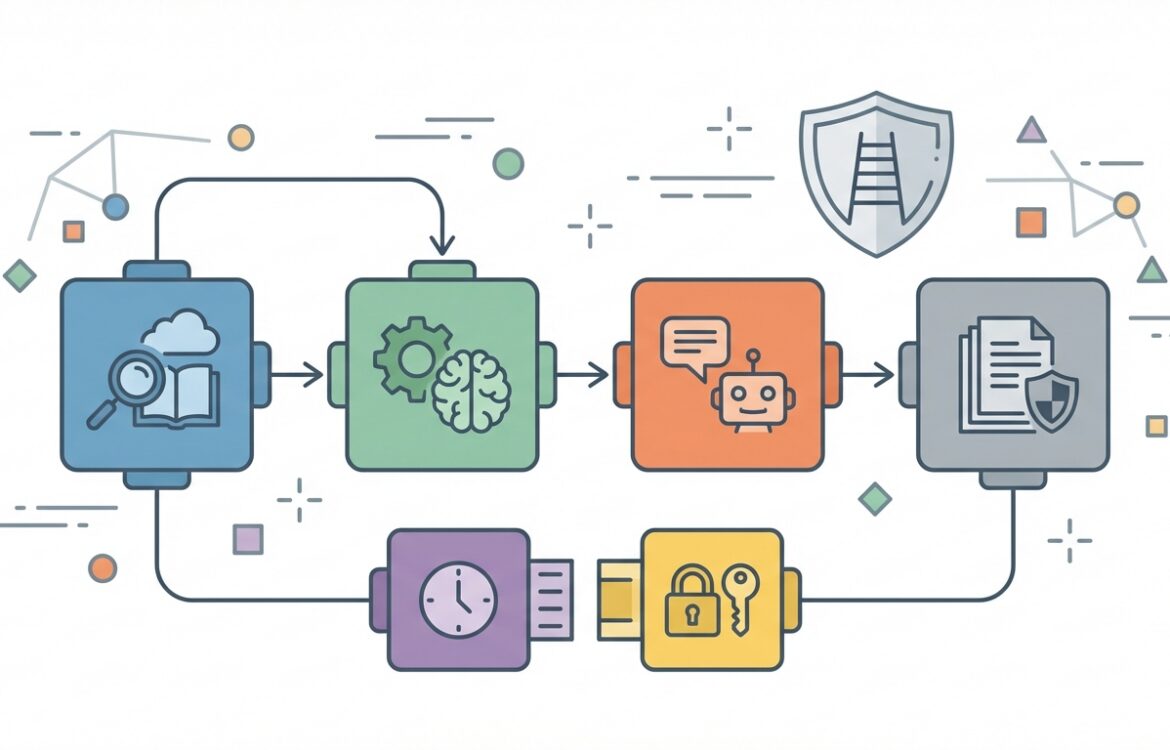
Career Moats in the AI Era: Building Durable Advantage with RAG, Fine‑Tuning, Evaluation, Tooling, and Infrastructure
Scope and assumptions: this article defines what a “career moat” means for AI engineers, highlights technical specializations that create durable career value, and evaluates the concrete architectures, tooling, deployment patterns, and governance responsibilities that sustain those moats. I assume you are an engineer or engineering manager with working knowledge of LLMs, embeddings, and production infrastructure. Where statements are time- or research-sensitive I cite sources; where evidence is ambiguous I explicitly say so.
This article uses the phrase Career Moats in the AI Era to mean technical skills, processes, and system designs that are hard to replicate, are operationally valuable, and survive rapid model churn (for example when new base models appear). The recommendations focus on engineering realities (latency, cost, observability, governance), not on career coaching platitudes.
This article is for informational purposes and does not constitute security or legal advice.
Conceptual overview: Career Moats in the AI Era
A career moat is a defensible position: a mix of domain expertise, system knowledge, tooling proficiency, and organizational process that competitors cannot quickly copy. In the AI era a moat is less likely to be a single model or library and more likely to be a combination of capabilities around architecture patterns (e.g., retrieval‑augmented generation), parameter‑efficient adaptation (PEFT), evaluation and monitoring pipelines, secure model governance, and reliable infrastructure. Employer demand for AI literate roles and upskilling continues to rise, creating opportunity for engineers who pair deep technical practice with production discipline. Recent industry reporting and workforce analyses show strong growth in AI skills demand and employer preference for AI‑capable applicants; organizations are also investing unevenly in training which creates openings for specialists who can operationalize AI capabilities. (news.microsoft.com)
How it works (step-by-step)
Below are repeatable technical building blocks that together form durable career moats for AI engineers. Each block includes what to implement, why it creates value, and practical notes about trade‑offs.
-
Ground knowledge with RAG (Retrieval‑Augmented Generation). Implement a retrieval layer (document loaders → embedding model → vector index → retriever) that injects verified external context into model prompts at inference time. This reduces dependence on a specific base model’s cutoff date and allows you to maintain single‑source truth for domain data. RAG architectures vary: standard 2‑step RAG (retrieve then generate), agentic RAG (LLM drives retrieval), and hybrid variants. Pick the pattern that maps to your latency and control requirements. (docs.langchain.com)
-
Use parameter‑efficient fine‑tuning (PEFT) strategically. When you need persistent task adaptation, prefer PEFT approaches (LoRA, adapters, prompt‑based adapters) over full model reweights where possible to reduce storage, enable fast switching, and simplify governance. LoRA and related techniques are established and supported in open source tooling; newer hybrid PEFT techniques and federated variants are experimental and may change practices. Document exactly which parameters are trainable and keep adapter checkpoints separate from base model artifacts. (github.com)
-
Implement evaluation as a first‑class engineering activity. Build automated evaluation suites covering accuracy/faithfulness (fact checking), instruction/behavior fidelity, safety filters, and performance metrics. Use a mix of reference‑based benchmarks and targeted human annotations; recent research proposes structured checklists and LLM‑assisted evaluation frameworks to increase repeatability and interpretability. Evaluation must be reproducible, versioned, and integrated into CI/CD gates. (arxiv.org)
-
Apply an operational governance framework. Use a risk‑management framework to map assets, identify failure modes, define acceptable risk, and enforce controls. NIST’s AI RMF (and its generative AI profile) is a practical starting point for organizations to govern model lifecycle risk across design, deployment, and monitoring. Governance work (requirements, testing policies, runbooks) forms a durable moat because it ties technology to legal, compliance, and operational teams. (nist.gov)
-
Invest in observability, monitoring, and feedback loops. Production LLM systems require telemetry for latency, token usage, retrieval relevance (precision/recall), hallucination detection, and user feedback. Monitoring must include both system metrics and content quality signals (e.g., claim verification, calibration/uncertainty measures). Research on hallucination detection and uncertainty quantification shows multiple viable approaches; implement ensemble checks (retrieval verification, model self‑consistency, external fact checks) rather than relying on a single metric. (direct.mit.edu)
-
Choose infrastructure and tooling deliberately. Use modular, well‑documented stacks: vector stores and embedding services for retrieval, orchestration frameworks for batch indexing, and composable libraries for building RAG (LangChain and similar OSS provide practical building blocks). Keep adapters, indexes, and prompts in version control and automate reindexing and re‑embedding workflows. Tooling knowledge (how to integrate vector DBs, embedder choices, and retriever tuning) is valuable and often nontrivial to hire for. (langchain.com)
Design choices and trade-offs
Below are frequent design decisions engineers face when building moats and the trade‑offs that determine long‑term value.
-
RAG latency vs factuality. Adding retrieval improves factual grounding but adds network and index latency. For strict SLAs prefer 2‑step RAG with aggressive caching; for exploratory assistants consider agentic/hybrid RAG that trades predictability for richer reasoning paths. The correct choice depends on query patterns, working set size, and acceptable cost per query. (docs.langchain.com)
-
PEFT vs full fine‑tuning. PEFT reduces storage and permits rapid model switching, but may not achieve the same level of performance as full fine‑tuning on some tasks. Newer PEFT hybrids show promise but can be experimental; evaluate PEFT variants against held‑out tasks and monitor for catastrophic forgetting in continual updates. (github.com)
-
Open models vs hosted APIs. Running open models in‑house gives control over data and may lower per‑inference costs at scale, but increases operational burden (serving, GPU management, security). Hosted APIs simplify operations and shift compliance responsibilities, but create data governance and latency trade‑offs. Companies that make infrastructure and secure deployment a competency can capture a durable advantage.
-
Indexing granularity and chunking. Smaller chunks improve retrieval precision but increase index size and can fragment context; larger chunks preserve context but can waste token budget and decrease retriever relevance. Use domain‑specific validation to choose chunking and maintain an iterative re‑embedding schedule when your data distribution or embedder changes. (medium.com)
-
Evaluation depth vs speed. Extensive human evaluation and multi‑metric audits increase trustworthiness but are costly. Operationally, implement lightweight automated checks for continuous gating and reserve human review for high‑risk outputs or periodic audits. Use LLM‑assisted checklists only as one signal; validate them against human labels when accuracy matters. (arxiv.org)
Common implementation mistakes
These are recurring errors that erode potential career moats; avoiding them is practical competitive advantage.
-
Treating models as static IP. Locking a system around a specific base model or prompt without an upgrade path makes the product brittle. Design adapters, index formats, and prompt templates so they can be re‑applied to new base models with minimal changes. (github.com)
-
Under‑engineering retrieval verification. Feeding retrieved context into an LLM without reranking, citation checks, or source attribution causes hallucination and legal risk. Implement rerankers and explicit verification steps when content supports high‑stakes decisions. (topquadrant.com)
-
Skipping reproducible evaluation and versioning. Not versioning indexes, adapters, prompts, and evaluation suites prevents root cause analysis when performance changes. Use artifact registries and CI gates for model and index changes. (arxiv.org)
-
Relying on a single monitoring signal. Using only latency or only user satisfaction as the monitoring trigger misses subtle failures like subtle factual drift or model misalignment. Combine system and content signals. (direct.mit.edu)
-
Neglecting governance early. Waiting until scale to build compliance and risk controls creates rework and increases legal exposure. Start with a pragmatic RMF‑style mapping (identify assets, map harms, set controls) and iterate. (nist.gov)
Testing, evaluation, and monitoring
Testing and monitoring are the operational core of any career moat around AI engineering. Below are practical systems and signals to implement.
-
Automated test harnesses. Maintain unit tests for prompt templates, integration tests for retrieval pipelines (synthetic queries with expected document hits), and regression tests for adapters and scoring functions. Automate these in CI to catch breaking changes early.
-
Metric categories to track. Track system health (latency, error rates, token usage), retrieval quality (recall@k, reranker precision), content quality (factuality checks, hallucination detectors, safety filter hit rates), and business outcomes (task completion, user retention). Use both automated metrics and human annotation for calibration. Research shows uncertainty quantification and multi‑metric benchmarks are helpful building blocks for this class of monitoring. (direct.mit.edu)
-
Hallucination and factuality detectors. Implement layered defenses: (1) verify claims against retrieved sources, (2) apply model self‑consistency checks or belief‑propagation detectors, and (3) route high‑risk outputs to human review. Recent academic work proposes checklist‑style LLM evaluation frameworks and probabilistic detectors—use these as part of a hybrid approach rather than as single sources of truth. (arxiv.org)
-
Data and model drift checks. Monitor data distribution changes in incoming queries and retriever results; re‑embed and re‑index when the corpus meaning shifts or when you change embedding models. Keep drift thresholds tied to business risk to avoid unnecessary rework. (medium.com)
-
Incident postmortems and knowledge capture. When a model error impacts users, run a cross‑functional postmortem that traces index, prompt, adapter, and infra changes. Capture mitigation playbooks and push them into runbooks that engineering teams practice. This process builds organizational memory that is difficult to replicate and therefore contributes to a moat. (nist.gov)
FAQ
What specific technical skills create Career Moats in the AI Era?
High‑value technical skills include designing and operating RAG systems (indexing, embedding choice, retrieval tuning), implementing PEFT adapters and training pipelines (LoRA and related methods), building robust evaluation suites that combine automated and human signals, and operationalizing observability and governance (NIST AI RMF is a practical reference). Engineers who pair these skills with domain knowledge and production engineering experience are difficult to replace. (docs.langchain.com)
Is PEFT (like LoRA) an established practice or experimental?
PEFT methods such as LoRA are established and widely used in industry because they reduce stored checkpoint size and enable efficient task adaptations; Microsoft’s LoRA implementation and community tooling are mature. Newer PEFT hybrids and federated LoRA variants are active research areas and should be evaluated carefully before being used as critical production dependencies. (github.com)
How should I prioritize investments to build a moat within a 6–12 month horizon?
Prioritize: (1) reliable retrieval and index hygiene (RAG), (2) a minimal but reproducible PEFT pipeline for the most valuable tasks, (3) a basic automated evaluation suite with human‑in‑the‑loop checks for high‑risk flows, and (4) monitoring that combines system and content signals. These deliverables are low‑to‑medium effort and materially increase the defensibility of AI features. Use LangChain or equivalent composable libraries for prototyping but keep production artifacts modular and versioned. (docs.langchain.com)
How does governance (NIST AI RMF) map to daily engineering work?
NIST AI RMF provides structured functions (govern, map, measure, manage) that translate into concrete engineering artifacts: asset inventories, threat models, test suites, audit trails, and escalation/runbooks. Engineers operationalize the framework by implementing measurable controls (e.g., input filtering, output verification gates, and artifact versioning) and by providing evidence for compliance reviews. Start small and expand controls according to risk. (nist.gov)
Can non‑technical skills contribute to an AI career moat?
Yes. Communication, cross‑functional collaboration, domain expertise, and the ability to translate model behavior into product requirements are highly valuable. Employers frequently report that soft skills remain crucial even as technical AI skills become table stakes. Combining these human competencies with the technical blocks above magnifies the moat. (axios.com)
Key references and further reading: NIST AI RMF and Generative AI Profile (practical governance starting points); LangChain docs for RAG architectures and design patterns; Microsoft and community LoRA repos and PEFT literature for efficient adaptation; CheckEval and uncertainty quantification research for evaluation and monitoring approaches. (nist.gov)
Practical next steps for engineers: pick a high‑value internal dataset, build a simple RAG pipeline and a test harness that validates retrieved context, implement a PEFT adapter for one core task and automate CI validation, and add monitoring that combines retrieval and factuality signals. These concrete outputs materially increase your team’s ability to ship safe, maintainable AI features—and they create the technical and process artifacts that form career moats.
Established practice vs experimental techniques — summary list:
-
Established practice: 2‑step RAG patterns with retriever + reranker, LoRA/PEFT for efficient adaptation, CI‑integrated evaluation suites, NIST AI RMF for governance, and vector stores + embedding services as infrastructure. (docs.langchain.com)
-
Experimental / active research: agentic RAG at scale with guaranteed safety, federated PEFT aggregation algorithms, advanced hallucination detectors tied to internal latent signals, and some hybrid PEFT strategies — promising but still under active evaluation in the literature. Implement these cautiously and with fallback plans. (arxiv.org)
Concluding note: building a career moat in the AI era is an engineering discipline. The most resilient moats are multi‑dimensional: a combination of system architecture (RAG, adapters), production rigor (testing, monitoring, versioning), governance (risk frameworks), and domain fluency. Technical breadth is useful, but durable advantage comes from owning the full lifecycle that connects model outputs to business outcomes and legal compliance. Where recommendations reference active research, I’ve cited sources; where practical experience matters, prioritize reproducible engineering work that your organization can operate and audit over one‑off model experiments.
Selected citations: LangChain RAG and retrieval docs; NIST AI RMF and Generative AI Profile; Microsoft LoRA repo and PEFT references; CheckEval evaluation framework; uncertainty quantification and hallucination detection literature; industry workforce analyses (LinkedIn, Microsoft Work Trend Index). (docs.langchain.com)

I focus on the engineering side of AI: how to design, ship, and operate LLM systems in the real world. I write about infrastructure, RAG, fine-tuning, evaluation, and cost–performance trade-offs, with an emphasis on turning technical decisions into reliable, scalable outcomes.