
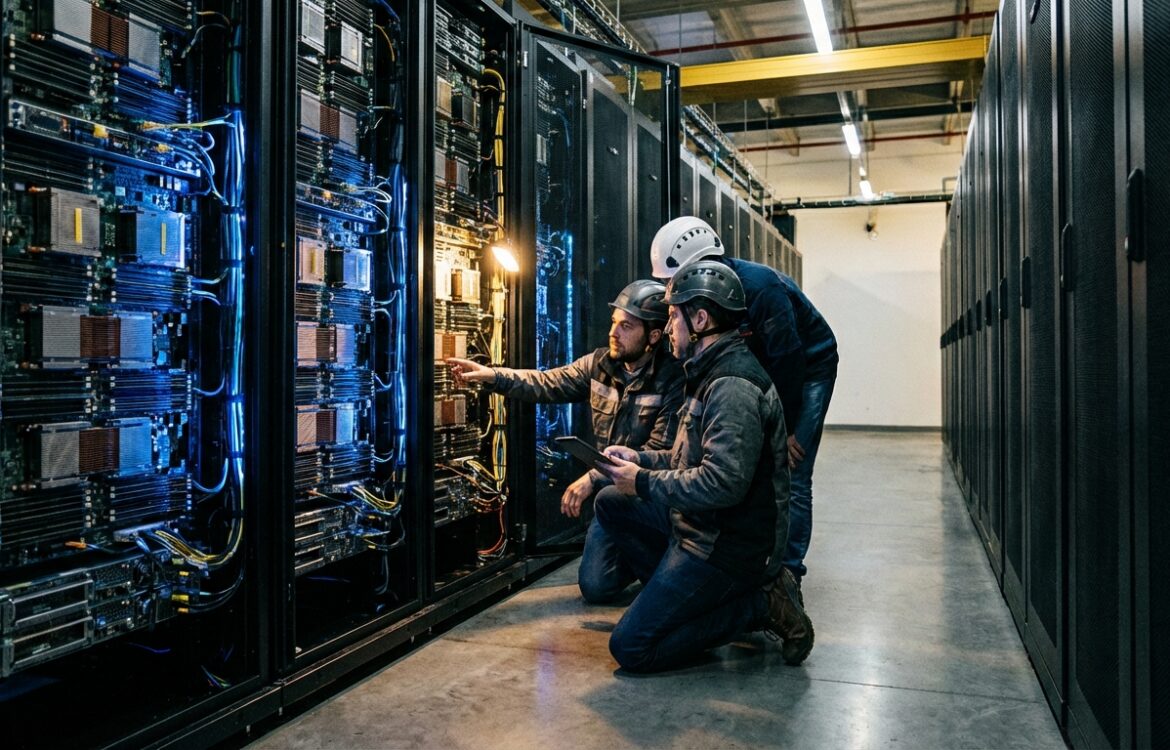
AI compute costs: current trends in compute, costs, and efficiency
This article examines the trend often summarized as Compute, Costs, and Efficiency Trends, focusing on AI compute costs: what is verifiable today, what is plausibly driving change, where credible experts disagree, and what teams should monitor when planning capacity or procurement. It synthesizes public announcements, benchmark results, peer-reviewed research and international energy analyses to keep conclusions evidence-led and uncertainty-aware.
What is happening now (verified signals)
Hyperscalers and cloud providers are shipping new accelerator generations that claim materially better price-performance for AI workloads. Google Cloud announced Cloud TPU v5e and subsequent TPU v5p / Trillium series with published MLPerf price-performance improvements, and company blog posts report multi-fold gains for training and inference compared with prior TPU generations. These announcements are positioned explicitly as cost and energy efficiency improvements for LLM training and serving workloads. (cloud.google.com)
Independent benchmark suites show measurable efficiency gains for real-world generative inference. MLCommons’ MLPerf Inference v5.0 results indicate a rapid increase in generative-AI-focused submissions and large improvements in throughput and latency results for the same model families compared to prior rounds — a sign that both hardware and software stacks are improving end-to-end inference efficiency. (mlcommons.org)
Research on algorithmic and software-level optimizations that reduce inference and fine-tuning costs continues to mature. Techniques such as 4-bit quantization, QLoRA (quantized low-rank adapters) for efficient fine-tuning, and hybrid schemes that quantize weights and activations have produced peer-reviewed or preprint results showing substantial reductions in memory footprint and reported throughput speedups without catastrophic loss of accuracy. These papers provide concrete options teams can adopt to lower per-query and per-finetune compute requirements. (arxiv.org)
Energy and infrastructure demand tied to AI is rising and is now a subject of formal international analysis. The International Energy Agency (IEA) has published scenarios in which electricity consumption for data centres increases materially through 2030, with accelerated (AI-focused) servers accounting for a large share of that growth. These analyses highlight that compute scale choices have energy, cost, and sustainability implications at national and corporate levels. (iea.org)
Supply-side constraints and geopolitics are also affecting availability and terms for the highest-end accelerators. Recent reporting about advanced accelerator export controls, vendor payment terms, and constrained inventories demonstrates that procurement costs and lead times for top-tier chips can be volatile and shaped by regulation as well as manufacturing capacity. (reuters.com)
What’s driving the change
Three broad forces explain the current trends in AI compute costs and efficiency.
- Hardware generational improvements and specialization: Hyperscalers and chip vendors iterate on accelerator architecture, interconnect, and memory subsystems (e.g., TPU v5 family, Trillium and Google’s reported improvements) with the explicit goal of improving FLOPS-per-dollar and FLOPS-per-watt for typical LLM workloads. These system-level gains reduce unit training/serving costs when software fully exploits the hardware. (cloud.google.com)
- Software and model-efficiency techniques: Quantization, low-rank adapters, distillation, pruning and sparsity, and smarter tokenization/response strategies reduce memory, compute, and energy per inference or per fine-tune. Work such as QLoRA and 4-bit inference papers provide replicable methods teams can use to reduce costs without wholesale hardware upgrades. (arxiv.org)
- Benchmarking and feedback loops: Community benchmarks like MLPerf increasingly focus on generative LLM scenarios; this creates a productive feedback loop where hardware vendors optimize for those workloads and framework / kernel authors deliver improved runtimes — accelerating real-world price-performance gains. (mlcommons.org)
Secondary drivers include market dynamics (large customers negotiating capacity and preferring fixed-price or bulk deals), energy and sustainability pressures that influence datacenter design and location, and regulatory actions that influence supply chains for leading-edge silicon. (reuters.com)
What experts and credible sources disagree about
There are several well-documented points of professional disagreement — largely about magnitude, timeline, and systemic effects rather than the basic existence of efficiency improvements.
- How fast per-inference costs will fall across the board: Hardware vendors publish price-performance improvements for specific setups and benchmarks; interpreters disagree on how much of those gains translate directly to diverse, production workloads. Benchmark-focused gains may be larger than what a particular enterprise workload realizes without engineering investment to recompile kernels or change model architectures. The MLPerf and vendor posts document gains, but the realized gains depend on workload parity. (mlcommons.org)
- Optimal scaling strategy for models: DeepMind’s Chinchilla results argue that many very large parameter-count models were trained suboptimally relative to compute budgets and that compute-optimal model/data tradeoffs reduce downstream compute and inference cost. Other groups note that larger models trained with more compute sometimes still produce practical benefits for specific tasks, leaving debate about the best practical trade-off for different applications. These are empirical questions that depend on task mix, latency targets, and available data. (arxiv.org)
- Energy and environmental trajectory: The IEA models clear growth in electricity demand for AI-accelerated servers, but experts disagree on how much efficiency and renewable integration will offset that growth. Some researchers highlight the potential for AI to optimize energy systems (mitigating impact), while critics warn that unchecked model scale and more frequent retraining could materially increase absolute consumption. The IEA provides scenario analysis, not fixed forecasts. (iea.org)
- Supply and geopolitical risk effects on cost: Journalistic reporting shows export controls and vendor supply policies affecting the availability and commercial terms for the most advanced chips; analysts disagree on whether these frictions will permanently raise costs or simply shift procurement patterns and accelerate in-region supply alternatives. Recent reporting on advanced chip export policy and vendor rules illustrates the uncertainty. (reuters.com)
When sources disagree, they typically describe different plausible scenarios rather than contradict provable facts; the right operational response therefore depends on a team’s risk tolerance and timescale.
Practical implications (for teams, creators, or users)
For engineering and procurement teams:
- Do a portfolio analysis: measure actual per-request cost on representative workloads rather than extrapolating from vendor benchmarks. Benchmarks show direction and potential magnitude but not your realized production delta. (mlcommons.org)
- Prioritize software-first optimizations before buying the next-generation hardware: adopt quantized inference, mixed-precision, and efficient fine-tuning strategies (e.g., QLoRA, 4-bit kernels) to lower memory and GPU-hours required. These methods can reduce costs substantially without large capex. (arxiv.org)
- Consider heterogeneous strategies: use cheaper accelerators (or CPU) for low-priority or batch workloads and reserve premium GPUs/TPUs for training or latency-sensitive inference. Hyperscaler offerings that expose newer TPU/accelerator generations can make this easier to implement without heavy upfront procurement. (cloud.google.com)
- Plan for energy and sustainability: factor electricity cost, PUE (power usage effectiveness), and local grid reliability into total-cost-of-ownership — not just rack price or GPU-hours. The IEA analysis suggests energy demand is a growing, material line item for large-scale AI operations. (iea.org)
- Negotiate flexibility in contracts: given supply volatility at the high end, seek spot/reserved blends, and shorter-term commitments where possible to avoid being locked into overpriced or hard-to-provision capacity. Recent reporting on chip export and vendor terms shows procurement conditions can change quickly. (reuters.com)
For creators and product teams:
- Optimize model architecture and prompt/serving strategy to reduce token counts and compute per query. Distillation or smaller compute-optimal models can offer similar user outcomes at lower serving cost for many tasks. (arxiv.org)
- Measure latency-cost trade-offs: batched vs single-token generation, caching, and response truncation can reduce total inference spend without changing model weights. MLPerf data shows that software and runtime improvements are being continuously pushed; product teams need to keep up to capture those gains. (mlcommons.org)
What to watch next (signals and metrics)
Teams should track a small set of high-signal metrics and publications to make timely, evidence-based decisions:
- MLPerf (training and inference) results and new benchmark suites — look for improvements in median submission throughput, not just best-case numbers. (mlcommons.org)
- Vendor price-performance posts and release notes for new accelerator generations (e.g., Cloud TPU / Trillium announcements) — read technical notes to understand the workload assumptions behind claimed gains. (cloud.google.com)
- Peer-reviewed and preprint research on quantization, LoRA/QLoRA, sparse models and compute-optimal scaling (e.g., Chinchilla and QLoRA/QUIK papers) — these indicate practical levers teams can apply in software. (arxiv.org)
- Energy and policy reports (IEA and national analyses) and supply-chain / export-control news that may affect availability and price of top-tier chips. (iea.org)
- Internal telemetry: per-token latency, GPU-hours per experiment, cost per served request, and batch-utilization — use these to quantify how much vendor or software advances will change your P&L. (This is an internal metric recommendation; measure continuously.)
Watching these signals together — benchmarks, vendor technical notes, primary research, energy/policy reports, and your own telemetry — gives the most balanced view of likely near-term changes in AI compute costs.
This article is for informational purposes and does not constitute investment or business advice.
FAQ
What are the quickest levers to reduce AI compute costs?
Software optimizations typically pay back faster than hardware purchases: adopt quantized inference (4- or 8-bit where acceptable), low-rank adapter fine-tuning (QLoRA-style workflows), batching and caching strategies, and model distillation for lower-latency services. Peer-reviewed preprints and community implementations document practical throughput and memory improvements for these techniques. (arxiv.org)
How much will new accelerator generations reduce my bill?
Vendors publish price-performance improvements for specific benchmarks; MLPerf shows the ecosystem is improving throughput for generative workloads. However, realized savings depend on workload similarity to benchmarked tasks and the engineering effort to exploit new hardware. Treat vendor claims as upper-bound potential and validate with pilot runs. (cloud.google.com)
Are larger models always more expensive to serve?
Larger parameter counts generally increase inference memory and latency costs, but research (e.g., Chinchilla) shows that models trained at compute-optimal sizes can be smaller and more efficient while matching or exceeding some larger models’ performance, reducing downstream inference costs. Application goals determine whether a very large model is necessary or if a compute-optimal or distilled model will suffice. (arxiv.org)
Which external signals should procurement watch for changes in compute pricing?
Track MLPerf releases, vendor release notes/price-performance announcements, major supply-chain and export-control news (which can affect availability and lead times), and energy/IEA reports that can change total cost of ownership for in-region datacenters. (mlcommons.org)
How should small teams balance cloud vs on-premises for cost efficiency?
Small teams often benefit from cloud access to new accelerators (pay-as-you-go and flexible capacity) combined with software efficiency practices. On-premises can make sense with predictable, sustained load and where negotiating bulk hardware deals offsets capex and O&M, but supply volatility and rapid hardware iterations can complicate long-term TCO. Validate with workload-specific cost modelling and short cloud pilots before committing to large capex. (cloud.google.com)

I explore how AI is reshaping work, creativity, education, and decision-making, grounding every topic in evidence rather than hype. I write about real trade-offs—open vs closed models, compute costs, information quality, and organizational impact—so readers can understand what actually matters and what to watch next.